Posts tonen met het label Forty Four (1954). Alle posts tonen

vrijdag 31 juli 2020

Minglewood Blues (1928) / New Minglewood Blues (1930) / Forty Four (1954) / Going Back To Memphis (1954) / Highway 61 (1932) / New New Minglewood Blues (1967)


"Minglewood Blues" is a blues-song, first recorded by Cannon’s Jug Stompers in 1928. Noah Lewis was a member of that band. 
Two years later, he struck out on his own with the Noah Lewis Jug Band and recorded "New Minglewood Blues"
It was this version that the Grateful Dead drew from for their rendition, hence the title "New, New Minglewood Blues"

This song is structured in the AAB blues pattern using 12 bars, a very common structure in blues music. Many Blues songs are structured using the AAB format.

The blues standard "Rollin' and Tumblin'" or "Roll and Tumble Blues", first recorded by Hambone Willie Newbern in 1929, took several elements from "Minglewood Blues".

But here are the versions and adaptations of "Minglewood Blues"

(o) Cannon's Jug Stompers (1928)  (as "Minglewood Blues")
Gus Cannon, bj, jug; Ashley Thompson, g, voc; Noah Lewis, hca
Recorded January 30, 1928 at Memphis Auditorium in Memphis, TN
Released on Victor 21267


Don't you never let one woman worry your mind (2)
Then she keep you worried, worried all the time

Don't you wish your Sarah was little and cute like mine (2)
She's a married woman but she comes to see me some time

Don't you never let your woman rule your mind (2)
She keep you troubled, worried all the time

Well I got a letter, lord, you ought to heard it read (2)
If you're coming back baby now be on your way

Listen here:


Two years later Noah Lewis then wrote a new arrangement, called "New Minglewood Blues", loosely based on the earlier "Minglewood Blues".
All the verses from the new version were borrowed from 2 earlier songs:

"Water Bound Blues" by Texas Alexander (recorded June 15, 1929)

Lyrics borrowed:

I was raised in the desert, born in a lion's den (2x)
Says, my chief occupation takin' monkey men's women

Listen here (at 2 min and 7 seconds in the YT below)


"It Won't Be Long" by Charley Patton (recorded June 14, 1929)

Lyrics borrowed:

If you ever go down Memphis, stop by Menglewood (2x)
You Memphis women don't mean no man no good


Listen here (at 34 sec in the YT below):


(c) Noah Lewis's Jug Band (1930)  (as "New Minglewood Blues")
Noah Lewis, h/v; John Estes, g; Yank Rachel, md; Ham Lewis, j.
Recorded November 26, 1930 in Memphis, TN
Released on Victor 23266


I was born in a desert, raised in a lion’s den (2x)
And my regular occupation is seeking women from other men

When you come to Memphis, please stop by Minglewood (2x)
There's women in the camp don't mean no man no good

Listen here:


In 1932 Roosevelt Sykes used the complete same verse that Noah Lewis had borrowed from Charley Patton. But his stop was not at Menglewood but at Hollywood.

(c) Roosevelt Sykes (1932)  (as "Highway 61")
Recorded September 22, 1932 in Richmond, IND
Released on Champion S-16586


If you ever been to Memphis, you stop down in Hollywood (2x)
Lord the women out there, don't mean no one man no good 

I'm leaving St Louis, I'm going out Grand Avenue (2x)
I got to go to Memphis, something over there that I want to do 

When I hit Grand, look like my troubles just begun (2x)
Lord it breaks my heart, to sing about Highway Sixty-One 

I felt so blue, while I was out on that lonely highway (2x)
I say I'm riding now, but maybe my trouble will end some sweet day 

I can stand right here, look down on Beale Avenue (2x)
I can see everything, that pretty Miss so-and-so do 

Oh listen kind mama, don't worry about your dad when I'm gone (2x)
You know I'm wild about your kind Mama, I ain't going to do nothing wrong

Listen here:


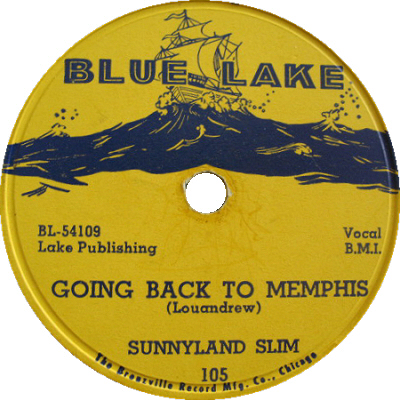
Sunnyland Slim used the AAB blues pattern for "Going Back To Memphis".

(c) Sunnyland Slim (1954)  (as "Going Back to Memphis"
Sunnyland Slim, voc, p; Snooky Pryor, hca; Eddie Taylor or Floyd Jones, g
Recorded early 1954 in Chicago, IL;
Released on Blue Lake 105


Listen here:


A few years later Sunnyland Slim used the same AAB blues pattern to cut a new song, with floating lyrics from "Going Back To Memphis".

(c) Sunnyland Slim (1957) (as "Highway 61")
Recorded in 1956 in Chicago, ILL
Released on Cobra 5006


Listen here:


Noah Lewis' "New Minglewood Blues", with the adapted lyrics, was covered by the Grateful Dead in 1967 on their first album as "New New Minglewood Blues".
The band used the collective pseudonym "McGannahan Skjellyfetti" for their group-written arrangement. 


I was born in a desert, raised in a lion's den (2x)
And my number one occupation is stealing women from their men

If you're ever in Memphis, better stop by Minglewood  (2x)
Well take a walk down town, the women sure look good 

If you can't believe me, don't make it hard to believe in you  (2x)
'Cause we all need each other, well you know it's true

I was born in a desert, raised in a lion's den (2x)
And my number one occupation is stealing women from their men

Listen here:


In 1967 the Jim Kweskin Jug Band covered "Minglewood Blues" incorporating lyrics from both "Minglewood Blues" and "New Minglewood Blues".

(c) Jim Kweskin Jug Band (1967)  (as "Minglewood")


Listen here:


In 1977 Doc & Merle Watson also covered "Minglewood Blues" incorporating lyrics from both "Minglewood Blues" and "New Minglewood Blues".

(c) Doc & Merle Watson (1977)  (as "Minglewood Blues")


Listen here:


And in 1998 John Sebastian and the J Band with Geoff Muldaur also covered "Minglewood Blues" incorporating lyrics from both "Minglewood Blues" and "New Minglewood Blues".

(c) John Sebastian and the J Band with Geoff Muldaur (1998)  (as "Minglewood Blues")


Listen here:


In 1954 Howlin Wolf  copied the AAB blues pattern and melody from "Minglewood Blues"
for his adaptation of Roosevelt Sykes' "44 Blues".


(c) The Howlin' Wolf (1954)  (as "Forty Four")
Howlin' Wolf, v, h; Otis Spann, p; Jody Williams, Hubert Sumlin, g; Willie Dixon, b; Earl Phillips, d.
Recorded in October, 1954. Chicago.
Released on Chess 1584


In 1954, when Howlin' Wolf recorded his version, "Forty Four" took on a new outlook. 
Backing Wolf, who sang and played hamonica, were Hubert Sumlin and Jody Williams (electric guitars), Otis Spann (piano), Willie Dixon (bass), and Earl Phillips (drums). 
Together they transformed "Forty Four" into a Chicago blues, with prominent guitar lines and an insistent "martial shuffle on the snare drum plus a bass drum that slammed down like an industrial punch-press". Wolf retained Sykes' handgun reference and added "Well I'm so mad this morning, I don't know where in the world to go." 

I wore my forty-four so long, I've made my shoulder sore (2x)
Well, I'm wonderin' everybody, where'd my baby go

Well, I'm so mad this mornin', I don't know where in the world to go (2x)
Well, now I'm lookin' for me some money, pawned gun to have some gold 

With Howlin' Wolf's gruff and overpowering vocal style, the overall effect was menacing.

Listen here:


(c) Rising Sons (1965)  (as ".44 Blues")
With Gary Marker, Ry Cooder & Taj Mahal;
Only released in '92. (crediting Willie Dixon)


Listen here:


(c) Captain Beefheart (1967)  (as "Sure 'Nuff 'n Yes I Do")
The Rising Sons arrangement of Howlin Wolf's "Forty Four" (HERE ABOVE) influenced Capt. Beefheart's "Sure 'Nuff 'n Yes I Do" for sure, with both Gary Marker & Ry Cooder involved in the Beefheart session. ALSO SEE: Joop's Musical Flowers: 44 Blues (1929) 
Beefheart adapted the first line ("I Was Born In The Desert") from "New Minglewood Blues" / "Water Bound Blues".  SEE: Joop's Musical Flowers: Minglewood Blues (1928) / New Minglewood Blues (1930) 


Listen here:


Several artists would copy Howlin Wolf's adaptation of "44 Blues".

Johnny Winter in 1968, Little Feat in 1971 and Robert Plant in 2012 are a few examples.


In 1972 Neil Young recorded "Are You Ready For The Country", which also has the AAB blues pattern and melody from "Minglewood Blues"

Listen here:


SEE ALSO: 


dinsdag 23 september 2014

44 Blues (1929) / Vicksburg Blues (1930) / Forty Four (1954) / Little Girl (1966)


This song is structured in the AAB blues pattern using 12 bars, a very common structure in blues music. Many Blues songs are structured using the AAB format.

"Forty-Four" or "44 Blues" is a blues standard whose origins have been traced back to early 1920s Louisiana.

"Forty Four" was published in Thomas W. Talley's 1922 collection Negro Folk Rhymes: Wise & Otherwise. As such, this could be a precursor of the "Forty Four" Blues songs,


"The Forty-Fours," as its earlier form was sometimes referred to, was a piano-driven "barrelhouse honky-tonk blues" that was performed as an instrumental.
Little Brother Montgomery, who is usually credited with the development of the song, taught it to another blues pianist along the way by the name of Lee Green; Green, in turn, taught it to Roosevelt Sykes.
As Sykes explained: "He [Lee Green] was the first guy I ever heard play the "44" Blues. Several people had been playing it through the country of course — Little Brother Montgomery and several others, but nobody had ever recorded it and there was no words to it, no words or lyrics at all. So Lee Green, he took a lot of time out to teach me how to play it." By the time he recorded it in 1929, Roosevelt Sykes supplied the lyrics and called the song "44 Blues":
It was not until after Sykes recorded "44 Blues" that Green and Montgomery recorded their versions of "The Forty-Fours." While instrumentally both were similar to Sykes' version, the subject matter and lyrics were different. Lee Green recorded his version, titled "Number Forty-Four Blues" , two months after Sykes.
About one year later, Little Brother Montgomery recorded his version titled "Vicksburg Blues".
----> SEE: Vicksburg Blues

Of the three, Roosevelt Sykes' version was the most popular and "was to be far more influential than Green's version." "[Sykes' lyrics] played on the differing interpretations of the phrase 'forty-fours' — the train number 44, the .44 caliber revolver and the 'little cabin' on which was the number 44, presumably a prison cell." "Undoubtedly, these overlays of meaning generally appealed to other singers, accounting for the frequent use of Sykes' lyrics."

Well I walked all night long, with my .44 in my hand (2x)
Now I was looking for my woman, found her with another man

Well I wore my .44 so long, Lord it made my shoulder sore (2x)
After I do what I want to, ain't gonna wear my .44 no more

Now I heard my baby say, she heard that 44 whistle blow (2x)
Lord it sounds like, ain't gonna blow that whistle no more

Now I got a little cabin, and it's number 44 (2x)
Lord I wake up every morning, the wolf be scratching on my door


(o) Roosevelt Sykes (1929)  (as "44 Blues")
Roosevelt Sykes, voc, p
Recorded June 14, 1929 at 11 Union Square, New York City
Released on Okeh 8702


Listen here:


(c) Lee Green (1929)  (as "Number Forty-Four Blues")
Recorded August 16, 1929 in Chicago.
Released on Vocalion 1401


Ah, my baby cryin and I didn’t hear the 44 whistle when she blows (2x)
And then I feel mistreated and your sweet mama bound to go.

Ah, baby, when you get lonely and think you want to go (2x)
You know that you ain’t no better, mama, than the black woman that I had before

Some of these mornins mama, baby and it won’t be long (2x)
You gonna look for your daddy, baby, and I’m goin to be gone.

I got blues will last me nine months from today (2x)
I’m gonna get my sweet woman to drive my blues away.

[Piano Instrumental]

Ah, little baby when you get lonely and want to go (2x)
You ain’t no better, baby, than the black woman that I had before

Listen here:


(c) James Wiggins (1929)  (as "Forty-Four Blues")
James Wiggins, voc; Blind Leroy Garnett, p
Recorded October 12, 1929 in Richmond, IN;
Released on Paramount 12860-A and on Broadway 5061 (as by James Harris)


James Wiggins closely follows Roosevelt Sykes "44 Blues"

Listen here:


(c) Little Brother Montgomery (1930)  (as "Vicksburg Blues")
Recorded September 1930 in Grafton, WI.
Little Brother Montgomery: vocals and  piano
Released on Paramount 13006-A


I've got the Vicksburg Blues and I'm singin it everywhere I go (2x)
Now the reason I'm singin', my babe says she don't want me no more

I've got the Vicksburg Blues and I'm singin it everywhere I please (2x)
Now the reason I'm singin', it is to give my poor soul ease

[Piano solo]

Now I ain’t gonna be your Lord, I'm down no more

Now I don’t like this old place, mama, and Lord and I never will (2x)
I can sit right here in jail and look at Vicksburg on the hill.

Listen here:


Due to the song's popularity, many versions of "Forty-Four" appeared over the following years, including some that bore little resemblance to the original except for the title.
Sykes, Green, and Montgomery recorded it themselves ten times between 1929 and 1936.

Roosevelt Sykes re-recorded the song in 1930 with his alias Willie Kelly.

(c) Willie Kelly (1930)  (as "Kelly's 44 Blues")
Roosevelt Sykes, voc, p.
Recorded June 12, 1930 in Cincinnati, OH;
Released on Victor V-38608-A


Lord I say good morning Mr pawnshop man : as I walked in his door (2x)
I says I feel bad this morning : and I really wants my forty‑four

Lord I was at a party last night : I was out there till about half past two (2x)
I'm going back out there tonight : I'm out to have some shooting to do

Lord the policeman walked around me : they walked around me both night and day (2x)
When they know I got my forty‑four : they won't have a word to say

Then I made up in my mind : and I really don't care how I go (2x)
Before I'll be mistreated : I'm going to shoot my forty‑four

Listen here:


Or here:


And on December 11, 1933 Roosevelt Sykes recorded "New 44 Blues"
Released on Bluebird B 5323


Listen here:


Or here:


On November 4, 1930 Lee Green recorded a version called "Train Number 44",
accompanied by Roosevelt Sykes
and released on Vocalion 1566


Listen here:


Or here:


And on August 24, 1934 Green recorded a version called "44 Blues"
Released on Decca 7016

Listen here:


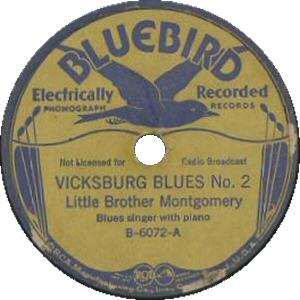
Little Brother Montgomery recorded "Vicksburg Blues No. 2" on August 10, 1935
Released on Bluebird B 6072


Listen here:


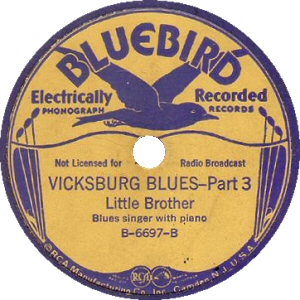
And "Vicksburg Blues Part 3" on October 16, 1936
Released on Bluebird B 6697


Listen here:


(c) Mae Glover (1931) (as "Forty-Four Blues")
Sometimes Mae Glover is credited for writing "Forty-Four Blues", but her version wasn't recorded until  February 24, 1931


Mae Muff (Glover):Vocals James Parker:Trumpet Charles O'Neil:Piano
Recorded in Richmond, IN. Tuesday, February 24, 1931
Originally issued on Champion 16351
And on Superior 2783 (as by Alberta Washburn)
Also released on Varsity 6053 (as by Mae Muff) (as "Big Gun Blues")


Listen here:


(c) Johnnie Temple (1936)  (as "New Vicksburg Blues")
Johnnie Temple, voc; Joshua Altheimer, p; Johnnie Temple or Charlie, McCoy, g
Recorded November 12, 1936 in Chicago, IL


Listen here:


 (c) Big Maceo (1945)  (as "Maceo's 32-20")
The "Forty-Four" theme was also used by Big Maceo in 1945 in his "Maceo's 32-20".
Big Maceo, voc, p; Tampa Red, g, # sp; Tyrell Dixon, dr
Recorded July 5, 1945 in Chicago, Ill.

Released on RCA Victor 20-2028


Listen here:


(c) Big Boy Crudup (1947)  (as "Crudup's Vicksburg Blues")
Arthur Crudup, voc, g; Ransom Knowling, b; Judge Riley, dr
Recorded April 9, 1947 in Chicago, IL
Released on RCA Victor 22-0029


Listen here:


In 1954 Howlin Wolf adapted Roosevelt Sykes' "44 Blues" and but used the AAB blues pattern and melody from "Minglewood Blues".

(c) The Howlin' Wolf (1954)  (as "Forty Four")
Howlin' Wolf, v, h; Otis Spann, p; Jody Williams, Hubert Sumlin, g; Willie Dixon, b; Earl Phillips, d.
Recorded in October, 1954. Chicago.
Released on Chess 1584


In 1954, when Howlin' Wolf recorded his version, "Forty Four" took on a new outlook.
Backing Wolf, who sang and played hamonica, were Hubert Sumlin and Jody Williams (electric guitars), Otis Spann (piano), Willie Dixon (bass), and Earl Phillips (drums).
Together they transformed "Forty Four" into a Chicago blues, with prominent guitar lines and an insistent "martial shuffle on the snare drum plus a bass drum that slammed down like an industrial punch-press". Wolf retained Sykes' handgun reference and added "Well I'm so mad this morning, I don't know where in the world to go."

I wore my forty-four so long, I've made my shoulder sore (2x)
Well, I'm wonderin' everybody, where'd my baby go

Well, I'm so mad this mornin', I don't know where in the world to go (2x)
Well, now I'm lookin' for me some money, pawned gun to have some gold

With Howlin' Wolf's gruff and overpowering vocal style, the overall effect was menacing.

Listen here:


(c) John Mayall's Bluesbreakers (1966) (as "Little Girl")
The guitar riff from Eric Clapton in Mayall's "Little Girl" was very likely copied from the riff in Hooker's "Forty-Four"

Listen here:


(o) Otis Spann (1965)  (as "Vicksburg Blues")


Listen here:


(c) Rising Sons (1965)  (as ".44 Blues")
With Gary Marker, Ry Cooder & Taj Mahal;
Only released in '92. (crediting Willie Dixon)


Listen here:


(c) Captain Beefheart (1967)  (as "Sure 'Nuff 'n Yes I Do")
The Rising Sons arrangement (HERE ABOVE) influenced Capt. Beefheart's "Sure 'Nuff 'n Yes I Do" (Ry Cooder arrangement) for sure, with both Gary Marker & Ry Cooder involved in the Beefheart session.
Beefheart adapted the first line ("I Was Born In The Desert") from "New Minglewood Blues" / "Water Bound Blues".  SEE: Joop's Musical Flowers: Minglewood Blues (1928) / New Minglewood Blues (1930) 


Listen here:


(c) Johnny Winter (1968) (as "Forty-Four")
In 1968 "Forty-Four" was brought into the blues-rock age by Johnny Winter on his The Progressive Blues Experiment album.
Winter's version was played at a faster tempo and had a more spare sound (trio of guitar, bass, and drums) dominated by Winter's guitar.

Listen here:


(c) Little Feat (1971)  (as "Forty-Four Blues / How Many More Years")
Little Feat recorded "Forty-Four Blues" (coupled with another Howlin' Wolf song listed as "How Many More Years," but actually "No Place To Go") on their 1971 debut album Little Feat. Little Feat's version, with piano and harmonica, was closer to Howlin' Wolf's, but it also featured the addition of slide guitar by Ry Cooder.


(c) Hound Dog Taylor (1971)  (as "44 Blues")


Listen here:


(c) Robert Plant and the Sensational Space Shifters (2012)  (as "44 Blues")
During their 2012 tour, Robert Plant and the Sensational Space Shifters performed "44 Blues", inspired by the Howlin' Wolf version.

Listen here:


In 1930 Roosevelt Sykes (as Willie Kelly) also recorded a follow-up of his "44 Blues"
a song (with another calibre) called "32-20 Blues".